Page 2 of 3
Re: LC Method Development Time Limit
Posted: Mon Feb 27, 2012 8:04 am
by unmgvar
vlad,
we use chromsword and we screen several buffers and for MeOH and ACN as well. so it is hard to fails a screening of certain column these days.
and in most cases, 99% of the cases failing to develop a method is that you indeed did not try the right column or mobile phase period.
for which case to try the 100 or obleisc R? the 14 compounds,
for the 100, if you think that it works for a mixture of bases, acids and neutrals, fix your website and teach your sales reps. i am not convinced of it at all, you'll need to elaborate if you think it is worth for you. the method is done anyway, we do not need to solve it further.
obleisc R might do it, but then again, your reps did not push that way, and also there is a chance that a third of the compounds might fall in the region of the void anyway like any other type of columns.
and it was done with a standard C-18, with 3 other vendors equivalent to it.
very important for us for the robustness of the method over years, with a C-18 it is easier to find most of the time a second column which is equivalent from another vendor.
we do not like to be single vendor dependent, this is why mixed modes are not yet a success in many labs.
so we do have mixed modes, we try them and we use them when they work, and again, unlike you try to state, they are as good as the resolution they give us for the application at hand and like all other columns we try, sometimes they work and sometimes they do not fit.
there is no single one solution approach that fits everything.
Re: LC Method Development Time Limit
Posted: Mon Feb 27, 2012 12:16 pm
by Vlad Orlovsky
Unmgvar,
Where are you located? I can conduct a seminar in your company and teach everything you need to know about mixed-mode. Right now i am trying to organize a mm tour in Europe in April-may. US seminars are easiee to conduct, i can jump on the plane any time. Please contact me by email if you are interested.
Re: LC Method Development Time Limit
Posted: Mon Feb 27, 2012 4:06 pm
by Vlad Orlovsky
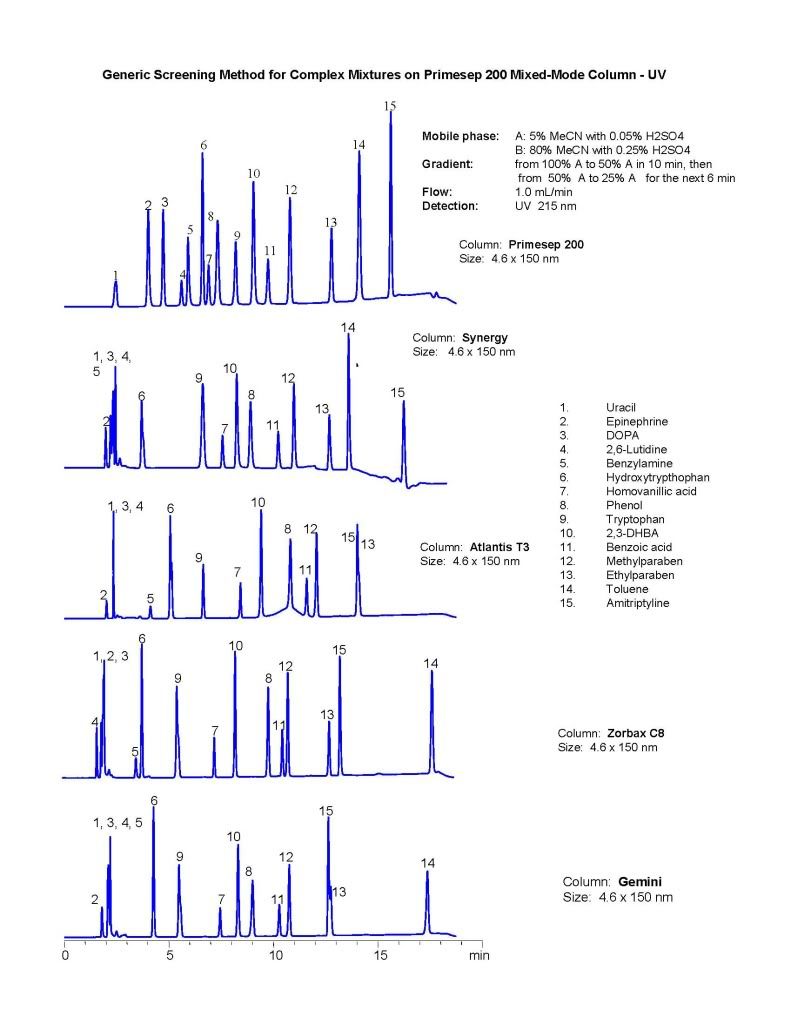
here is an example of low pH screening method for 15 compounds of different nature. Relative comparison for C18 columns, please note low retention for group of hydrophilic ionic compounds
Re: LC Method Development Time Limit
Posted: Tue Feb 28, 2012 10:21 am
by Russ
This is a nice comparison, but I am not sure that it is a correct one. In your experiment bids are only different in color. In chromatography analytes are different by several parameters (hydrophobicity, polarity, ionic properties, etc). The correct experiment would be to mix colored bids with other shaped colored objects. So even in your case you can separate them by shape and color using simple mesh (after you separate them by color) or just spreading them on a flat surface. Chromatography is science of selectivity.
My point at the presentation was to show people what 0.03 % or lower looked like. I thought that using the objects of the same size and shape but different colors to represent the different types of chemical compounds did that. Besides, you could find a large enough bead where only a few would be needed to make up the bulk which would make the separation issue seem fairly simple, which was not my point.
Re: LC Method Development Time Limit
Posted: Tue Feb 28, 2012 11:37 am
by Peter Apps
What different worlds are covered by chromatography ! - here Vlad shows "complex" sample with 15 compounds in it. In GC of natural mixtures you can get 15 peaks every minute for a 60 minute run.
Peter
Re: LC Method Development Time Limit
Posted: Tue Feb 28, 2012 7:08 pm
by tom jupille
That's what a quarter of a million plates will get you!
And (for the uninitiated -- I know that Peter already knows and appreciates this) that's a fundamental difference between GC and LC. GC gives you lots of plates but only limited control over selectivity (stationary phase and temperature). The latter gives you a much wider range of options to control selectivity (stationary phase, solvent type, pH, temperature, additives), but has an order of magnitude lower plate count.
Re: LC Method Development Time Limit
Posted: Tue Feb 28, 2012 8:16 pm
by Vlad Orlovsky
As majority of the drugs are tested by HPLC and not GC, I think it is fair to call the mixture of 15 different compounds a "complex" one. This is appliation to show a scope of mixed-mode. We are working on the approach to combine efficiency of GC with versatility and selectivity of HPLC (and this is not UPLC)....but don't tell anybody

Re: LC Method Development Time Limit
Posted: Tue Feb 28, 2012 8:47 pm
by unmgvar
Ha Vlad, the mine is better than yours commercial picture.
can you say if the application was done on all columns the same way before i comment?
thank you
Re: LC Method Development Time Limit
Posted: Tue Feb 28, 2012 10:04 pm
by Vlad Orlovsky
If your separation is better then it is good for you and your company. Did you really run the same mixture
Fair question is how long it took you to get a better separation and how many columns you have screened to do that - basically how much it cost your company to develop a method.
Same conditions of mobile phase for experiments, different days and different Agilent 1100 systems, also we had to do some blank subtraction due to high background on one of the columns, but to be fair the column was pretty old. The goal was to develop a generic screening method for walk-in labs for complex/not-so-complex mixtures.
Re: LC Method Development Time Limit
Posted: Wed Feb 29, 2012 8:20 pm
by unmgvar
so if you have started from 100% buffer and not with 5% ACN, and made another gradient profile, it is very probable that another column would have worked as well from those that are shown here, hence i call the picture "my column is better than yours"
in the specific conditions i made to show that only my column works and no other of the competition,
but let's be practical and make the discussion worth something if you are ready to contribute
we have a request to transfer a bismuth application from AA to HPLC.
the detection needs to be UV or VIS. so derivatization is required.
and another one is for free gadolinium and Gd-DOTA and free DOTA. this one should be with a FL detector
we can probably make a solution by C-18, but what would you do with mix mode?
Re: LC Method Development Time Limit
Posted: Wed Feb 29, 2012 8:53 pm
by Vlad Orlovsky
We tried starting from 5% ACN and it did not change anything, we even started from 0% and some of the phases had a phase collapse. It was worse chromatography for RP column when we started with lower ACN, and there were still no separation for first 3-5 compounds.
Regarding your request:
1. I am not aware of any bismuth derivatization. Is it bismuth ion or bismuth metal? If it is metal I have no idea how you can do it. If it is ion, may be it forms colored complex with EDTA for example, like Cu ion and Fe ion do, in this case you can do ppb levels.
2. I think that complex of DOTA and Gd is not going to survive in HPLC and you might need to look at DOTA and Gd (3+) separately and then do calculations. We already have method for DOTA and I can send it to you if you send me inquiry through our website. Send me email and we can discuss how to tackle this issue.
I welcome you to try RP for DOTA, my guess your peak shape is going to be ugly.
P.S. we once had something similar:
http://www.sielc.com/Compound-Nitroprusside.html
Re: LC Method Development Time Limit
Posted: Wed Feb 29, 2012 9:23 pm
by unmgvar
vlad i do not want to send you a mail, i want the discussion public
I need to look at all structures and run 2-3 experiments to get separation and anybody can do the same
let's do it
instead of the commercial application, here are real day life cases.
we have 2 possible solutions by c-18 for bismuth, but maybe mixed mode can be simpler
DOTA is very polar, so a mixed mode or polar embedded c-18 could work.
anyway chelation is one way to go in both cases, being on the polar side could be feasible
to me it looks like an interesting case for mixed modes, and this also connects to the original posting.
how hard is it to develop a method, really.
Re: LC Method Development Time Limit
Posted: Wed Feb 29, 2012 9:48 pm
by Vlad Orlovsky
unmgvar
Are you undercover for CIA? You know who I am but I have no idea who you ar, so our discussion is one-sided.
In my opinion there is no sense to discuss it here, once we have method we can publish it on the forum. What are we discussing here theory or practice? We already have a method for DOTA and I don't have neither bismuth or Gd in the lab. My guess is that it will cost you (or your customer) few thousand dollars to develop a method
So let me know once you succeed or fail to develop this method, and I will go from there.
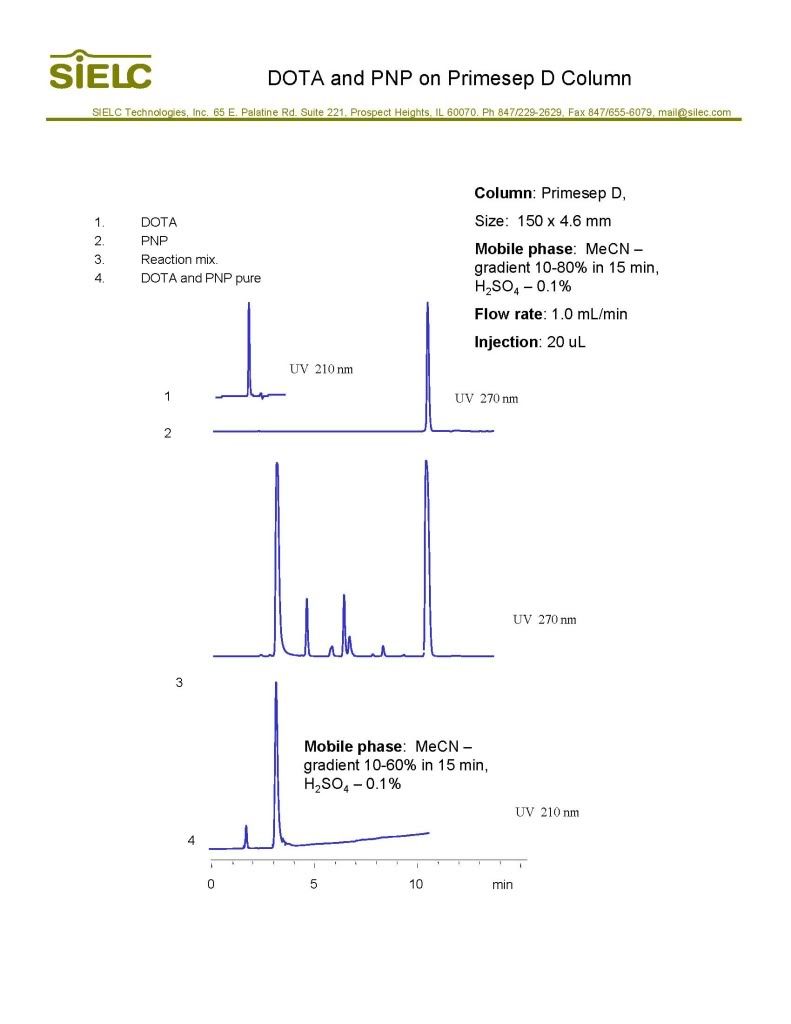
here is method for DOTA-PNP. We had slightly different task - to separate DOTA and DOTA-PNP
Re: LC Method Development Time Limit
Posted: Wed Feb 29, 2012 10:16 pm
by Vlad Orlovsky
With our mixed-mode columns we barely spend 8 hours in developing a method for 5 compounds, in 90% cases it is just few runs if we know structure and our task is defined in terms of sample matrix, detection technique, desire run time and buffer, etc. Mixed-mode allows you to analyze a much wider range of compounds in terms of polarity and ionic properties. These are reasons why we offer free method development for our customers. Just tell your manager that somebody else can do it for free (or don't tell the manager and pretend that you did this work
unmgvar,
To be fair to me I stated that in 90% cases we barely spend 8 h, I guess your case is falling into 10%. Although there are couple of methods in place for analysis of DOTA-Gd complexes as well as bismuth ions. I am not sure that you can benefit from mixed-mode in this case.
Here what I would use fro DOTA, may be DOTA behaves similar to EDTA
http://www.sielc.com/Compound-EDTA-Ethy ... -Acid.html
Re: LC Method Development Time Limit
Posted: Thu Mar 01, 2012 9:26 pm
by unmgvar
vlad i do think you gave up too fast.
DOTA is very polar, by looking at the structure it is easy to figure out.
as for the mine is better than yours pictures shows columns that we have used without problems with 100% buffer for a few minutes and then moved into a gradient of organic. but maybe your columns are sensitive. i have to admit i kind of think the 5% acn make the other columns look bad.